FlippedHealth
By flipping the perspective of healthcare — from systems to patients, from data to insight — Flipped Health builds the future of chronic care.
A Future of Hope and Possibility
Flipped Health embraces a future where every patient receives care tailored to their specific needs, where technology bridges gaps in access, and where prevention is a cornerstone of health strategy. By fostering collaboration among scientists, clinicians, and communities, Flipped Health aspires to create a healthcare system that is just, compassionate, and forward-thinking. Through the dedication and passion of its founders, Flipped Health is not just a non-profit organization; it is a movement toward a more equitable and innovative healthcare landscape.
About us Our Story
Innovators Launch Non-Profit for Personalized Medicine and AI/ML Tools in chronic disorders
A group of visionary healthcare professionals (HCPs) embarked on a mission to revolutionize the future of medicine.
Recognizing the potential of personalized medicine and AI/ML tools to transform patient care, they founded the non-profit organization, Flipped Health in 2019.
About us Our Ambition
Flipped Health is committed to develop innovative technologies and services that empower patients and healthcare providers alike.
The initiative focuses on three key areas


Personalized Medicine
Leveraging the power of AI and machine learning, Flipped Health aims to create tools that tailor treatments to individual patients’ genetic profiles and medical histories. This approach promises to enhance the effectiveness of interventions and improve outcomes.

Equity of Access
The organization is dedicated to ensuring that cutting-edge medical technologies and resources are accessible to all, regardless of socioeconomic status. Flipped Health advocates for policies that reduce healthcare disparities and collaborates with community partners to deliver services to underserved populations.

Preventive Strategies
By focusing on prevention, Flipped Health seeks to reduce the incidence of chronic diseases. Utilizing AI-driven predictive analytics, the organization supports early detection and lifestyle interventions that can prevent diseases before they develop.
Solutions
SolutionsFlipped Health Technology
Flipped Health Technology develops patient-centered digital solutions to address the rapid global growth of chronic diseases and their increasing burden on healthcare systems. We leverage data science and machine learning to transform real-world health data into actionable clinical insight, enabling earlier diagnosis, more personalized care pathways, and improved long-term outcomes.
Our technologies combine advanced analytics with remote expertise tools that connect patients and healthcare professionals to specialized knowledge, regardless of location. By integrating clinical data, longitudinal patient information, and predictive models, we support better decision-making across the care continuum.
Flipped Health Technology also designs early warning and alert systems that help anticipate clinical deterioration and prevent avoidable complications. Built with transparency, explainability, and ethical rigor at their core, our solutions are designed to integrate seamlessly into clinical workflows. Through close collaboration with clinicians, researchers, and health institutions, we turn complex data into trusted technologies that strengthen chronic care today and contribute to more resilient healthcare systems worldwide.
SolutionsFlipped Health Services
Flipped Health Technology develops patient-centered digital solutions to address the rapid global growth of chronic diseases and their increasing burden on healthcare systems. We leverage data science and machine learning to transform real-world health data into actionable clinical insight, enabling earlier diagnosis, more personalized care pathways, and improved long-term outcomes.

Our technologies combine advanced analytics with remote expertise tools that connect patients and healthcare professionals to specialized knowledge, regardless of location. By integrating clinical data, longitudinal patient information, and predictive models, we support better decision-making across the care continuum.
Flipped Health Technology also designs early warning and alert systems that help anticipate clinical deterioration and prevent avoidable complications. Built with transparency, explainability, and ethical rigor at their core, our solutions are designed to integrate seamlessly into clinical workflows. Through close collaboration with clinicians, researchers, and health institutions, we turn complex data into trusted technologies that strengthen chronic care today and contribute to more resilient healthcare systems worldwide.

SolutionsFlipped Health Institute
Through publications and training, Flipped Health Institute connects knowledge production with capacity building, helping healthcare actors navigate and shape the future of health.
Think Tank
Flipped Health Institute is the think tank and learning hub of Flipped Health, dedicated to rethinking how healthcare systems respond to the growing global burden of chronic diseases. The Institute brings together clinicians, researchers, data scientists, patients, caregivers, and health system leaders to explore new models of care grounded in real-world evidence, lived experience, and responsible innovation.
Its work is guided by an international Scientific Advisory Board, composed of recognized experts from different regions and disciplines, ensuring scientific rigor, ethical oversight, and global relevance. By fostering international dialogue and multidisciplinary collaboration, the Institute addresses the clinical, organizational, technological, and societal challenges shaping the future of health, with a strong focus on patient-centered and data-informed approaches.
Publications
Flipped Health Institute produces publications that contribute to informed debate and practical decision-making in healthcare. Drawing on research, field experience, and expert insight, our reports, white papers, and policy briefs explore the transformation of health systems, the management of chronic diseases, and the evolving role of data science, machine learning, and artificial intelligence in care. Our publications aim to bridge scientific rigor and real-world applicability, supporting a more equitable, sustainable, and effective vision of healthcare.
Training
Flipped Health Institute develops training programs dedicated to the challenges of future healthcare systems, with particular emphasis on the use of artificial intelligence and data in health. Designed for healthcare professionals, managers, decision-makers, and ecosystem stakeholders, our training initiatives combine conceptual frameworks with concrete use cases. They address topics such as chronic disease management, AI-enabled clinical support, remote expertise, data-driven decision-making, and organizational transformation. By fostering shared understanding across disciplines, our training programs help build the skills, critical thinking, and culture needed to turn technological innovation into meaningful and ethical impact.

News

Season’s Greetings and Best Wishes for 2026
January 2026
As we enter 2026, Flipped Health would like to extend its warmest wishes to healthcare professionals, researchers, partners, patients, and caregivers around the world.
In a context marked by growing health challenges and rapid transformation, we remain committed to advancing patient-centered, data-informed, and responsible innovation in healthcare.
We look forward to continuing dialogue, collaboration, and collective action in the year ahead, working together to shape more equitable, resilient, and sustainable healthcare systems.
Strengthening International Dialogue on Health System Transformation
December 2025
Flipped Health Institute continues to strengthen its international collaborations with leading think tanks and research organizations in the United States and Asia.
Through expert exchanges, joint reflections, and participation in international forums, the Institute contributes to cross-regional dialogue on chronic disease management, health system resilience, and responsible innovation. These collaborations support the development of globally relevant, patient-centered approaches to healthcare transformation.
To explore collaboration opportunities, please contact contact@flippedhealth.com.
Flipped Health Launches New Training Programs on AI and the Future of Healthcare
October 2025
Flipped Health Institute has released a new publication exploring how healthcare systems can better respond to the global rise of chronic diseases through patient-centered, data-informed models of care.
The report highlights the role of real-world data, data science, and machine learning in improving early diagnosis, care coordination, and long-term outcomes, while emphasizing the importance of ethical governance and clinical integration.
This publication contributes to ongoing international discussions on how to move from fragmented, reactive systems toward more anticipatory and sustainable approaches to chronic care.
To request the full publication or learn more about our work, please contact contact@flippedhealth.com.
Flipped Health Institute Releases New Publication on the Future of Chronic Care
September 2025
Flipped Health Institute is launching a new series of training programs dedicated to the challenges of future healthcare systems. Designed for healthcare professionals, decision-makers, and ecosystem stakeholders, these programs focus on the responsible use of artificial intelligence and data in health.
Through concrete use cases and interdisciplinary dialogue, the trainings address topics such as chronic disease management, AI-enabled clinical support, remote expertise, and organizational transformation. The initiative aims to support capacity building and shared understanding across healthcare ecosystems.
For more information about upcoming training sessions, please contact contact@flippedhealth.com.
Publications
Flipping Healthcare (2024)
Why Patients and Data — Not Systems — Should Drive the Future of Health
Authors : Pr Audrey Gabelle, Vijaya Kolachalama, Benoît Thieulin, Maxime Legrand (Intern), with contributions reviewed and endorsed within the framework of the Flipped Health Institute’s Scientific Advisory Board.
Abstract
Healthcare systems worldwide remain largely organized around institutional constraints rather than patient needs, despite decades of reform and technological progress. As chronic diseases become the dominant health challenge of the 21st century, this system-centric model is increasingly misaligned with the realities of long-term care.
This publication argues for a fundamental shift in perspective: flipping healthcare from systems to patients, and from fragmented data to shared, actionable insight. Drawing on international experiences, emerging digital health practices, and patient-reported data, the report explores how data science, machine learning, remote expertise, and early warning systems can support a more continuous, personalized, and anticipatory model of care.
Rather than presenting technology as an end in itself, the publication examines the cultural, organizational, and ethical transformations required to ensure innovation truly serves patients and society.
To request the full publication, please contact contact@flippedhealth.com.
Rethinking Chronic Care in a Data-Driven World (2024)
From Fragmented Systems to Patient-Centered Models
Authors : Pr Audrey Gabelle, Yacine Haddad, Maxime Legrand (Intern), with contributions reviewed and endorsed within the framework of the Flipped Health Institute’s Scientific Advisory Board.
Abstract
The global rise of chronic diseases is challenging healthcare systems that were historically designed to manage acute episodes of care. Fragmentation of services, delayed diagnosis, and limited coordination across care pathways continue to undermine outcomes for patients living with long-term conditions.
This publication explores how patient-centered, data-informed models of care can address these challenges by leveraging real-world data, data science, and machine learning. Drawing on international case studies and field experience, it examines how health systems can move from reactive care to anticipatory and preventive approaches, while preserving clinical judgment and ethical integrity.
The report proposes a strategic framework to align patients, healthcare professionals, and institutions around shared data, remote expertise, and coordinated decision-making, highlighting key success factors and governance principles required to transform chronic care at scale.
To request the full publication, please contact contact@flippedhealth.com.
Artificial Intelligence in Healthcare (2025)
From Promise to Practice: Building Trust, Impact, and Equity
Authors : Pr Audrey Gabelle, Benoît Thieulin, with contributions reviewed and endorsed within the framework of the Flipped Health Institute’s Scientific Advisory Board.
Abstract
Artificial intelligence is increasingly positioned as a catalyst for healthcare transformation, yet its real-world impact remains uneven and often poorly understood. This publication examines the conditions under which AI, machine learning, and advanced analytics can meaningfully support clinical practice and health system performance, particularly in the context of chronic disease management.
Focusing on explainability, clinical integration, and ethical governance, the report analyzes use cases such as early warning systems, remote expertise platforms, and decision-support tools. It emphasizes the importance of multidisciplinary collaboration, transparency, and patient involvement to build trust and ensure equitable access to innovation.
By bridging technological potential with operational realities, the publication offers practical recommendations for healthcare leaders, clinicians, and policymakers seeking sustainable and responsible AI deployment.
To request the full publication, please contact contact@flippedhealth.com.
Case Studies

Case Study AlzExperts
Expanding Access to Expert Knowledge in Alzheimer’s Disease
Context
Alzheimer’s disease is one of the fastest-growing chronic conditions worldwide. Despite scientific advances, patients and healthcare professionals continue to face delayed diagnosis, fragmented access to expertise, and significant territorial inequalities in care.
Healthcare professionals often lack timely access to specialized input, while scientific information remains abundant but difficult to translate into everyday clinical practice.
Challenge
AlzExperts addresses key structural challenges in Alzheimer’s disease care:
● Diagnostic uncertainty and prolonged care pathways
● Unequal access to expert opinion across regions
● Professional isolation in the management of complex cases
● Limited access to validated, practice-oriented information
The main challenge was to create a simple, reliable, and equitable way to connect clinical questions with expert knowledge.
Solution: The AlzExperts Platform
AlzExperts is a digital tele-expertise platform developed by healthcare professionals to support diagnosis and care in Alzheimer’s disease. Through a one-click interface, healthcare professionals, patients, and caregivers can submit questions and receive scientifically grounded responses within 72 hours.
Expert answers are based on validated scientific literature, clear levels of evidence, and structured expert review. A dedicated pathway allows patients and caregivers to access second opinions, preventive guidance, and emotional support.
Key Features
● One-click access to a structured network of Alzheimer’s experts
● Scientifically validated, practice-oriented expert responses
● Patient-centered design supporting professionals, patients, and caregivers
● Reduced geographic and organizational inequalities in access to expertise
● Contribution to real-world data on diagnostic and care practices
Impact
AlzExperts improves diagnostic confidence, supports timely clinical decision-making, and reduces professional isolation. By facilitating access to expert knowledge, the platform helps shorten diagnostic pathways and improve coordination of care.
For patients and caregivers, it enhances access to trusted information and expert guidance, contributing to a more equitable and supportive care experience.
Key Takeaways
● Tele-expertise strengthens access to specialized care in Alzheimer’s disease
● Structuring expert knowledge around real-world questions improves clinical practice
● Patient-centered digital platforms can reduce inequalities in chronic care

Case Study RespiraGuard AI
Anticipating Respiratory Failure Through Predictive Intelligence
Context
Acute respiratory failure remains a major cause of unplanned ICU admissions, morbidity, and mortality in hospitals worldwide. Although large volumes of physiologic and oxygenation data are continuously collected, critical signals often remain fragmented across electronic health records and underused in real time.
Clinicians are frequently forced to intervene late, once clinical deterioration has already occurred, increasing risk for patients and pressure on critical care resources.
Challenge
Hospitals face several interconnected challenges:
● Difficulty anticipating respiratory deterioration early enough
● Fragmented physiologic data across monitoring systems and EHRs
● High cognitive burden for clinicians in fast-paced environments
● Reactive rather than anticipatory escalation of care
● Increasing strain on ICU capacity and critical resources
The challenge was to transform existing data into early, actionable insight—without disrupting clinical workflows or replacing human judgment.
Solution: RespiraGuard AI
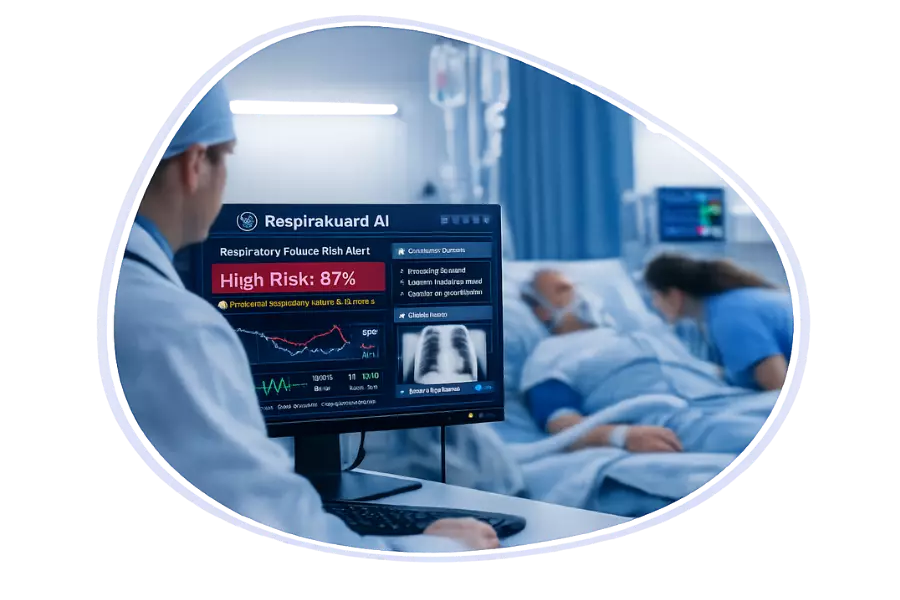
RespiraGuard AI is an AI-powered, respiratory-specific early warning system designed to anticipate clinical deterioration before it becomes critical. By continuously interpreting real-time physiologic and oxygenation trajectories, the platform predicts the risk of respiratory escalation up to 12 hours before mechanical ventilation may be required.
RespiraGuard AI connects signals that traditionally remain siloed within the EHR, transforming latent data into clear, trusted alerts that support timely clinical decision-making.
Key Features
● Continuous analysis of real-time respiratory and physiologic data
● Early warning of respiratory failure and clinical escalation
● Seamless integration into existing hospital workflows
● Explainable, transparent AI supporting clinician trust
● Decision support that augments—rather than replaces—clinical judgment
Impact
RespiraGuard AI enables clinicians to move from reactive rescue to anticipatory care. By identifying deterioration earlier, it supports safer hospital stays, reduces unplanned ICU transfers, and improves the sustainability of critical care resources.
For healthcare systems, the platform contributes to improved patient safety, operational efficiency, and more resilient hospital care models.
Key Takeaways
● Predictive intelligence can meaningfully improve respiratory care
● Early warning systems reduce clinical risk and resource strain
● AI delivers impact when embedded, transparent, and clinician-centered

Case Study EducAlz
Empowering Cognitive Health Through Education and Prevention
Context
Neurodegenerative diseases, including Alzheimer’s disease, represent a growing global health challenge, with the number of affected individuals expected to increase dramatically in the coming decades. Scientific evidence shows that cognitive decline develops over many years and is influenced by a combination of biological, environmental, lifestyle, and social factors.
While disease-modifying treatments remain limited and costly, strong evidence supports the role of prevention strategies in delaying cognitive decline and loss of autonomy—particularly when applied early and in a personalized manner.
Challenge
Despite robust scientific knowledge on cognitive risk and protective factors, major gaps remain:
● Limited access to clear, validated prevention information for the general public
● Insufficient health education adapted to diverse social and cultural backgrounds
● Difficulty translating scientific evidence into concrete, actionable behaviors
● Lack of personalized prevention strategies for individuals at increased risk
The challenge was to design a scalable, evidence-based approach that combines health education with personalized prevention, while addressing social and territorial inequalities.
Solution: The EducAlz Program
EducAlz is a comprehensive prevention and health education program designed to reduce cognitive decline risk and promote cognitive resilience. The program combines two complementary approaches: broad health education for the general population and targeted, personalized prevention for individuals at higher risk of developing Alzheimer’s disease.
Grounded in an extensive scientific literature review, EducAlz delivers educational content on early diagnosis, risk factors, and preventive strategies using accessible, innovative pedagogical tools. For targeted populations, the program integrates digital health tools to assess individual risk profiles and propose personalized, multimodal prevention pathways.
Key Features
● Evidence-based health education on cognitive risk and protective factors
● Multidomain prevention approach (physical activity, nutrition, sleep, cognitive stimulation, social engagement, stress management)
● Adapted educational tools for diverse populations, including socially vulnerable groups
● Personalized prevention strategies based on individual risk and cognitive reserve profiles
● Collaboration between academic centers, patient associations, and civil society actors
Impact
EducAlz promotes earlier awareness, empowerment, and engagement in cognitive health prevention. By improving access to validated information and supporting behavior change, the program aims to delay cognitive decline and reduce long-term loss of autonomy.
The initiative also strengthens links between research, clinical expertise, and population health, generating real-world insights to inform future prevention strategies and public health policies.
Key Takeaways
● Cognitive decline is not inevitable and can be influenced through early, multidomain prevention
● Health education is a powerful lever to reduce inequalities in cognitive health
● Personalized, data-informed prevention enhances individual engagement and impact
● Sustainable prevention requires collaboration across healthcare, academia, and society
Contact Us
Contact us for any questions regarding our work, projects, or collaborations.

contact@flippedhealth.com

Adress

Follow us